
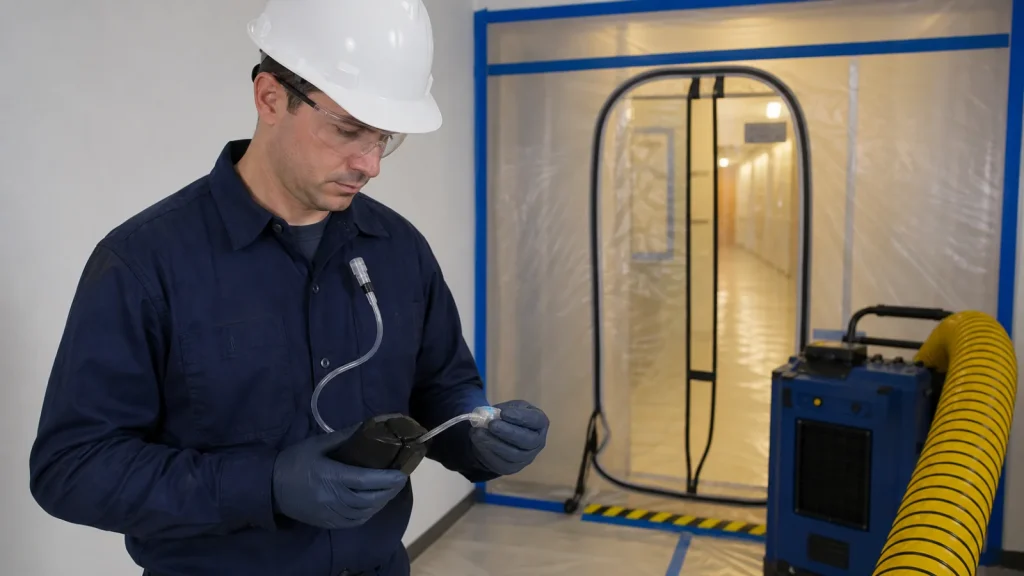
Air monitoring is one part of a broader asbestos abatement control program. Sampling provides documented information about airborne fiber concentrations at selected locations and times. When it is planned and interpreted correctly, that information can help evaluate work practices, identify changing conditions, document areas outside containment, and support completion or reoccupation decisions when the project requires it.
Different samples answer different questions
The phrase air monitoring can describe several activities. They are related, but they are not interchangeable:
- Personal exposure monitoring collects air from the breathing zone of a worker. It is used by the employer to evaluate occupational exposure and respiratory-protection requirements.
- Area or perimeter monitoring samples selected fixed locations, often outside the regulated work area, to provide information about project conditions and the effectiveness of isolation measures.
- Clearance monitoring is performed after required cleaning and visual review to determine whether the applicable completion criteria have been met.
Not every project uses every sample type, and the responsible party is not always the same. The written specifications, building type, work classification, and applicable federal and Texas requirements should define the monitoring plan before abatement begins.
Why planning matters
A useful sampling strategy identifies the purpose of each sample, the locations, the sampling duration, the analytical method, and how results will be communicated. Baseline information may also be collected before work so the project team has documented conditions for comparison.
Sample locations should reflect the actual project. Occupied spaces, entrances, waste routes, equipment exhaust, adjacent work areas, and other sensitive locations may require consideration. Placing pumps only where they are convenient can produce data that is difficult to apply to project decisions.
Monitoring during the work
As abatement proceeds, the technician records where and when samples are collected and notes the activity occurring during the sampling period. Flow rates, sample duration, equipment identification, and chain-of-custody records support the quality of the resulting data. The samples are then analyzed using the method required by the project or regulation.
The OSHA construction asbestos standard requires exposure monitoring in specified circumstances and explains how regulated areas, engineering controls, and employee exposure assessments work together. Monitoring data should therefore be read in the context of the task, controls, respiratory protection, and sample location rather than treated as an isolated number.
Texas public-building projects
Texas requirements add project-specific responsibilities for asbestos work in public buildings. The Texas Asbestos Health Protection Rules address appropriately licensed project monitoring and independent third-party area and clearance monitoring for covered abatement projects. The owner, consultant, and contractor should confirm roles before work begins so sampling, analysis, and reporting remain appropriately separated.
What happens when results need attention?
A result should be reviewed promptly against the sampling plan and the conditions observed during collection. Depending on the project, follow-up may include checking containment and negative-air equipment, reviewing work practices, pausing affected activities, performing additional cleaning, collecting additional samples, or revising controls. The appropriate response depends on what was sampled and why.
Clearance is more than a sample result
Final air sampling does not replace proper removal, cleaning, and visual inspection. Completion decisions should follow the project specifications and applicable rules. A work area that has not been adequately cleaned should not be treated as acceptable merely because one air sample produced a favorable result.
Documentation that supports decisions
Monitoring records should identify the sample type, location, date, time, flow information, work activity, analytical result, and any follow-up action. Clear records help owners, contractors, consultants, and laboratories communicate about project status without relying on memory or assumptions.
Conclusion
Air monitoring is most valuable when each sample has a defined purpose and is part of a coordinated control program. Environmental IQ develops monitoring around the building, abatement scope, occupied areas, and required decision points so the resulting information is practical, traceable, and relevant to the project.