
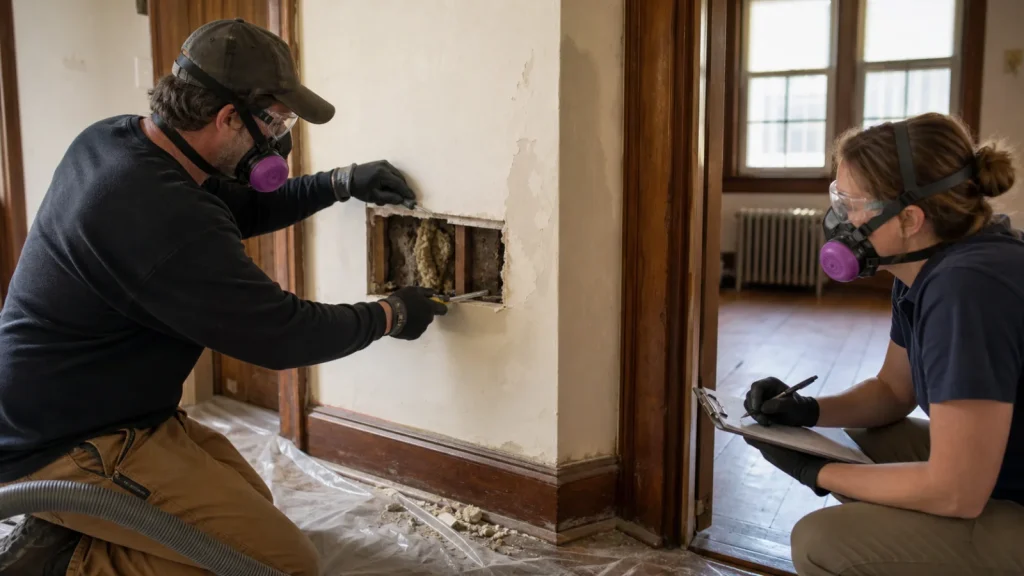
Insulation in an older home can tell part of the building history, but appearance alone cannot confirm whether it contains asbestos. The practical question is not simply whether an older material exists. Owners need to understand its condition, whether upcoming work will disturb it, and what information is needed before anyone enters the area or begins renovation.
Presence does not automatically mean exposure
Asbestos-containing material that remains intact and undisturbed is not the same situation as material that is damaged, cut, removed, or tracked through occupied space. The EPA advises homeowners that materials in good condition that will not be disturbed are not likely to pose a health risk. Testing every material in a home is therefore not always necessary when no damage or planned disturbance exists.
Risk can change when insulation is crumbling, exposed to water damage, repeatedly contacted, or located where electrical, plumbing, HVAC, roofing, or remodeling work will occur. Planning should focus on those conditions rather than relying on fear or assumptions based only on the age of the house.
Where suspect insulation may be found
Asbestos was used in several types of thermal and fire-resistant building products. Suspect material may be encountered around older pipes, boilers, ducts, furnaces, walls, ceilings, and attic spaces. Loose-fill insulation deserves particular care because entering an attic, moving stored items, or installing new utilities can disturb material over a broad area.
Color and texture are not reliable asbestos tests. Fiberglass, cellulose, mineral wool, vermiculite, and other insulation materials can have different installation histories, and some homes contain more than one type. A trained professional evaluates the material, location, condition, and planned work before recommending sampling or other action.
Vermiculite requires specific precautions
Vermiculite attic insulation is often a lightweight, pebble-like material that may appear gray-brown or silver-gold. A large share of vermiculite insulation historically sold in the United States came from a mine near Libby, Montana, where the material was contaminated with asbestos. For that reason, the EPA recommends assuming vermiculite insulation may be contaminated and leaving it undisturbed.
Homeowners should not dig through vermiculite to identify layers, open walls to search for it, sweep it, or collect a do-it-yourself sample. If attic or wall work will disturb the material, the project should be reviewed by a trained professional before work begins.
Activities that should trigger a review
- Adding recessed lighting, wiring, security systems, or communication cable.
- Replacing HVAC equipment or running new ductwork through an attic.
- Repairing a roof, ceiling, pipe, boiler, or mechanical system near suspect insulation.
- Converting an attic, opening walls, or removing ceilings during remodeling.
- Cleaning up after water intrusion, storm damage, or an accidental disturbance.
A practical planning sequence
- Pause the affected work. Do not move, sweep, vacuum, drill, or bag unknown insulation.
- Limit access. Keep occupants, children, pets, and unrelated workers away from the area until the condition is evaluated.
- Define the project. Identify exactly where workers need access and which materials may be contacted.
- Gather prior records. Look for previous surveys, laboratory results, renovation documents, or receipts that may describe the insulation.
- Request professional guidance. A qualified inspector or consultant can determine whether assessment, sampling, management in place, or removal planning is appropriate.
If insulation is damaged unexpectedly
Do not use a household or shop vacuum, dry broom, or compressed air on suspect debris. Those methods can spread fine material beyond the original area. Avoid walking through the debris and then entering occupied rooms. Restrict access and contact a professional who can evaluate the material and recommend an appropriate cleanup approach.
Health context
Asbestos-related disease is associated with inhaling airborne fibers. Health effects can include asbestosis, lung cancer, and mesothelioma, and disease may not appear until many years after exposure. Individual risk depends on factors such as exposure level, duration, frequency, fiber type, and smoking history. A building inspection cannot determine whether a past exposure caused a health effect; medical concerns should be discussed with a qualified healthcare provider.
Conclusion
Older insulation should be approached with care, not panic. If material is intact and will remain undisturbed, management in place may be appropriate. When renovation, maintenance, or damage could disturb suspect insulation, stop first and obtain project-specific guidance. Environmental IQ can help define the inspection scope and the documentation needed before work proceeds.