
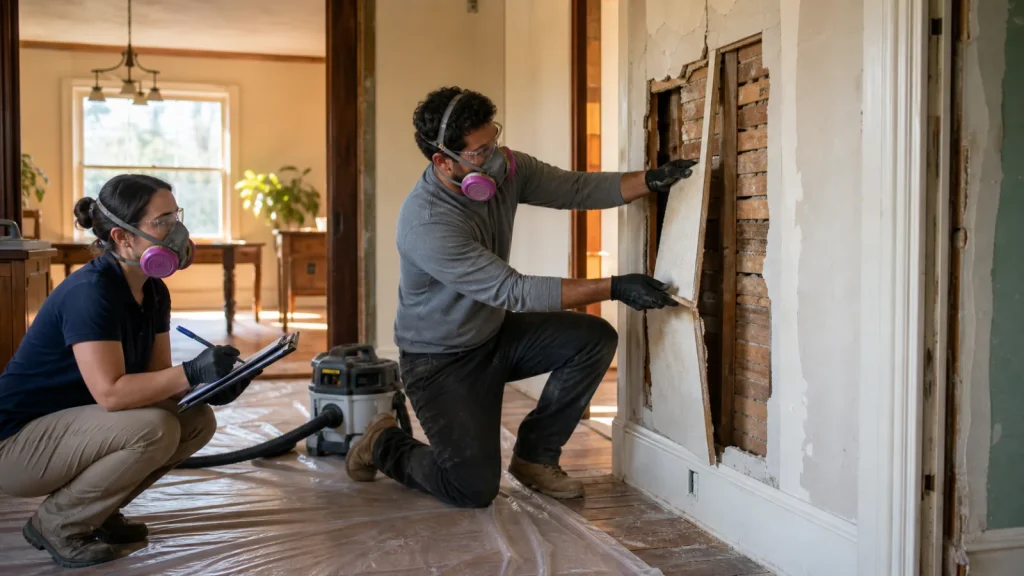
Austin properties range from early homes and mid-century commercial buildings to renovated offices, schools, apartments, and newer mixed-use spaces. That variety makes asbestos planning a project question rather than a simple age test. Before renovation or demolition begins, owners and contractors should understand which materials will be disturbed, what rules apply to the building, and how findings could affect the schedule.
Start with the planned disturbance
An asbestos review is most useful when it is tied to real work. Removing a floor, opening a wall, replacing a roof, cutting pipe insulation, or demolishing an entire structure each presents a different scope. A broad statement that a building is old does not tell a contractor which materials may be affected or what controls may be required.
Define the rooms, systems, exterior components, and concealed spaces involved before requesting an inspection. Clear scope information helps the consultant focus field work on the materials that could reasonably be disturbed and produce a report that supports design and pricing.
Building age is a clue, not a laboratory result
Older buildings are more likely to contain some asbestos-containing products, but no single construction date proves that every material is asbestos-free. Renovations may have introduced products at different times, and original materials may remain beneath newer finishes. OSHA has also explained that some buildings constructed after 1980 may still contain asbestos materials, so reliable records and project-specific due diligence remain important.
Visual appearance is not enough. Similar-looking floor tile, adhesive, wall texture, joint compound, roofing, insulation, cement products, or ceiling materials can have different compositions. Representative sampling and laboratory analysis are used when confirmation is needed.
Common project locations
Depending on the building and renovation history, suspect materials may be present in:
- Floor tile, sheet flooring, backing, and associated mastics.
- Ceiling tile, sprayed or troweled surfacing material, and textured coatings.
- Drywall systems, joint compounds, plasters, and wall panels.
- Pipe, boiler, duct, and other thermal-system insulation.
- Roofing, flashing, siding, cement board, and exterior sealants.
- Fire doors, equipment components, and other heat-resistant products.
Texas requirements depend on the property and project
Homeowner guidance, workplace requirements, Texas public-building rules, and the federal asbestos NESHAP are related but not identical. The Texas Department of State Health Services explains that a licensed asbestos inspector must conduct surveys in Texas public buildings. Federal NESHAP requirements apply to covered facilities and demolition or renovation activities, while some work at a single private residence may be treated differently.
Do not assume that a residential appearance automatically creates an exemption. Ownership, current use, the number of dwelling units, whether structures are part of a larger project, and the nature of the work can change the analysis. A qualified consultant should review the property and scope before the project team relies on a regulatory conclusion.
A better preconstruction checklist
- Map the work. Mark every area where materials will be removed, penetrated, sanded, cut, or demolished.
- Collect records. Gather previous surveys, laboratory reports, drawings, specifications, and known abatement documents.
- Schedule the survey early. Complete field work and laboratory analysis before bids and mobilization depend on unverified assumptions.
- Review the findings with the project team. Confirm which materials will remain, which will be disturbed, and whether design or abatement support is needed.
- Confirm notifications and responsibilities. The Texas DSHS notification FAQs explain the requirements for covered abatement, renovation, and demolition activities.
What a useful report should provide
A survey report should do more than list positive and negative samples. It should identify the inspected areas, material descriptions, sample locations, laboratory results, approximate quantities, observed condition, and important limitations. The owner should provide that report to the designer and contractors whose work may affect the identified materials.
If the design changes, review the report again. A survey prepared for one tenant suite or limited repair should not automatically be treated as coverage for a larger renovation or demolition.
If suspect material is discovered during work
Stop the activity in the affected area and avoid sweeping, vacuuming, or moving debris through occupied space. Preserve the condition, limit access, and compare the location against the existing survey. Material outside the original scope or concealed behind inaccessible assemblies may require additional evaluation before work resumes.
Conclusion
Asbestos planning should be a normal part of due diligence for Austin renovation and demolition projects, not a last-minute reaction after an unknown material is disturbed. A defined scope, timely inspection, clear report, and coordinated responsibilities help protect occupants and workers while reducing schedule surprises. Environmental IQ supports residential, commercial, and public-sector projects throughout Austin and surrounding areas.